

Scientist Spotlight: SURA Postdoc Researcher Natalia Quinteros Casaverde
As a child, Dr. Natalia Quinteros Casaverde dreamed of becoming an explorer, traveling the world and surveying natural beauty. Today, her camera roll captures scenes straight from those childhood aspirations: lush landscapes, far-off destinations, and photos of herself sporting an explorer’s hat.
Seated in front of a colorful Earth Day poster, leaf-shaped earrings framing her face, Quinteros Casaverde describes her current work as “a dream come true.” She is a SURA postdoc researcher in the Goddard Earth Sciences Technology and Research (GESTAR) II center, where she studies vegetation services in the Biospheric Sciences Laboratory at NASA Goddard Space Flight Center.
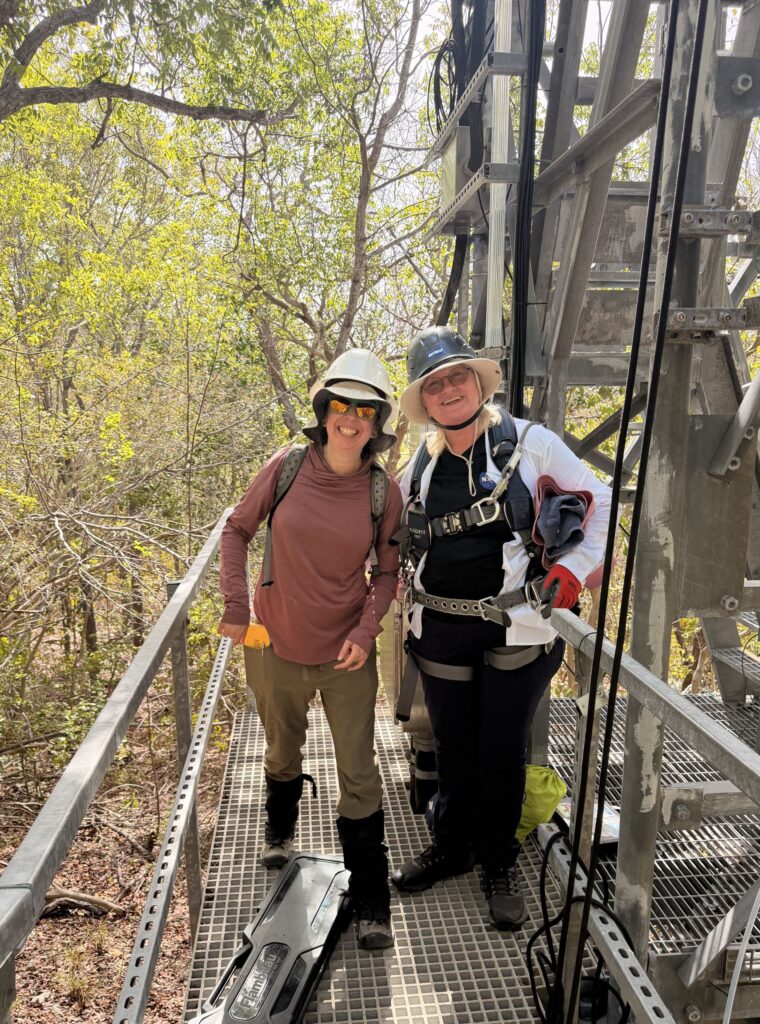
Dr. Quinteros Casaverde (left) and UMBC Professor Dr. Petya Campbell (right) wear their protective gear, or “explorer hat”, as they set up equipment for fluorescence measurements in the Guánica Dry Forest of Puerto Rico. (Edgar Castro | NASA)
In this role, Quinteros Casaverde is developing more accurate ways to monitor vegetation. Using imaging spectroscopy, a method for measuring light reflected by leaves at different wavelengths and different scales, she can uncover information about leaf structure, water content, and carbon use, revealing valuable clues about ecosystem health. This research has pulled her to different countries, different ecosystems, and different questions about these places, materializing her early ambitions into real-world scientific advancements.
Following the Light
Growing up, Quinteros Casaverde sampled the striking biodiversity across Peru, her home country, as her parents introduced her to the coastal deserts outside of Lima, the Andes mountains, and the Amazon rainforest. These early experiences fed her love for nature. During high school, a visit to a national park in the heart of the Amazon solidified her plans to pursue a degree in ecology.
However, her research journey did not begin with plants. Quinteros Casaverde likens the array of subjects in ecology to the options in a candy store. “You can work with anything you think about: insects, mammals, plants, frogs, reptiles.” She began her research studying birds and primates, but a conversation with a friend and mentor shifted her focus. “She told me, ‘When you start looking at plants, you look at everything. Because vegetation is what sustains the ecosystem.’” From then on, she turned her attention to the leaves.
Her newfound focus on vegetation led her to pursue a master’s degree in environmental science at Texas Christian University and a PhD in ecology and evolutionary biology at the City University of New York.
Quinteros Casaverde found the role that light plays in plant biology particularly mesmerizing and was interested in how plants competed for light across a forest canopy. Curious about what light could tell us about plant health, she was trained in leaf spectroscopy by Dr. Shawn Serbin, a scientist at Brookhaven National Laboratory who became her dissertation co-advisor. She applied these skills to samples from the New York Botanical Garden, building her doctoral dissertation around the use of leaf spectroscopy for identifying and characterizing plants.
From Leaves to Landscapes
During Quinteros Casaverde’s PhD, Serbin moved to NASA Goddard to lead the Biospheric Sciences Laboratory. When she later began searching for postdoc positions, Quinteros Casaverde was invited by Serbin to continue their leaf spectroscopy research at NASA. She joined the lab as a GESTAR II Research Postdoc through SURA. Led by the University of Maryland, Baltimore County (UMBC), GESTAR II brings NASA Goddard together with partner research organizations, including SURA, to train researchers and leaders in Earth science and to advance NASA’s goals for understanding our home planet.
As a SURA postdoc in GESTAR II, Quinteros Casaverde maps and validates measures of ecosystem functioning using leaf spectroscopy, working at a range of scales from individual leaves to entire forests. By improving how scientists assess vegetation health, her work can help researchers better understand how ecosystems respond to environmental change, with potential applications in agriculture, conservation, ecotourism, and climate resilience.
At NASA Goddard, Quinteros Casaverde has also supported international field campaigns, including the Airborne Validation Unified Experiment: Land to Ocean, or AVUELO, in Panama. Through the AVUELO campaign, she collects hyperspectral data from tropical ecosystems, adding to her broader work validating satellite data and analyzing vegetation health while moving her research beyond the laboratory into the environments she studies.
As her team identifies new patterns in leaf spectroscopy across different ecosystems, they can evaluate and confirm measurements from active satellites, such as the European Space Agency’s Fluorescence Explorer (FLEX) mission launched earlier this fall to collect data on Earth’s plant fluorescence and functioning. For Quinteros Casaverde, seeing how her research contributes to a broader understanding of Earth’s ecosystems keeps her grounded in her work.
GESTAR II has also expanded Quinteros Casaverde’s opportunities for professional growth. Her collaborations span the Smithsonian Tropical Research Institute (STRI), the U.S. Forest Service, the University of Maryland at College Park, the University of Wisconsin–Madison, and other NASA research teams. She describes colleagues eager to share their expertise, leaders who are engaged and accessible, and a culture of encouragement. “Being a GESTAR scientist has really opened my eyes to how I can grow within a program.”
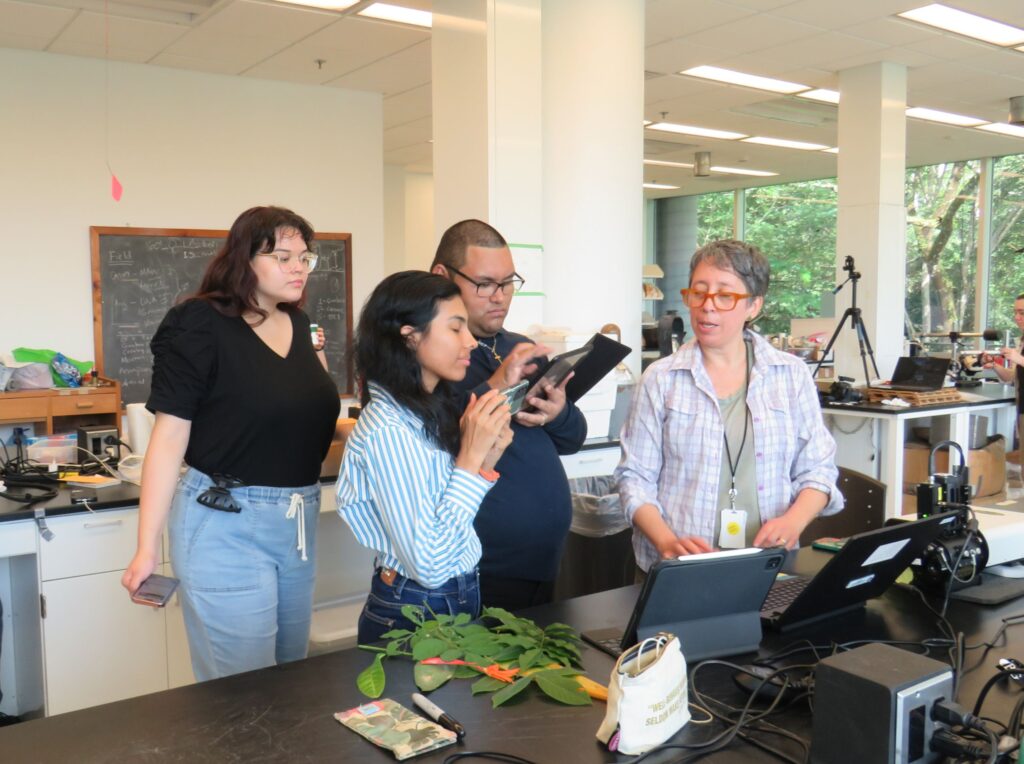
Panama’s Ministerio del Ambiente Interns Yenia Beatriz López Martínez, Klemelys Marelith Solis Castillo, and Brian Oliver Rodríguez listen as Dr. Quinteros Casaverde describes the purpose and process of measuring leaf light transmittance from field samples at the STRI Gamboa Lab during the NASA AVUELO Campaign. (Yoseline Angel | NASA)
Earth Science for Everyone
Quinteros Casaverde also gives back to the next generation of scientists, taking every opportunity to meet with aspiring researchers interested in Earth sciences. She shares her experiences with high schoolers and undergraduate students, reminding them that a career in science is about more than just technical expertise – it requires project management, interpersonal skills, and communication outside of scientific circles.
In her outreach, she hopes she can help others recognize how closely Earth science is connected to everyday life.
“The NASA Earth Science Division is really working for all of us and our well-being. Sometimes we divorce ourselves from nature, and we receive so much from it. At NASA, through collaborations and our instruments, we’re really looking into and monitoring the planet, and then going beyond that to help us adapt to the constant changes that the world faces.”
Quinteros Casaverde’s childhood dreams of exploring the natural world have taken shape in her research at NASA Goddard.
“It’s definitely worth being proud of and amazed by what we do here.”
About GESTAR II
The Goddard Earth Sciences Technology and Research II (GESTAR II) center aims to advance Goddard’s Earth science leadership by providing a competitive environment to hire and retain high-quality scientists who invest their expertise toward accomplishing NASA’s strategic missions and goals for the benefit of humanity.
About SURA
Southeastern Universities Research Association (SURA) advances the nation’s scientific enterprise through research operations and workforce solutions in partnership with government agencies, national laboratories, and its member universities.
Media Contact:
Anna Rader Groves
SURA Senior Advisor, Government Relations and Communications
Email: arader@sura.org
Artificial intelligence (AI) was used to edit for grammar, clarity, and coherence. All AI-generated suggestions were reviewed and approved by the author.