

Scientist Spotlight: Kyla Mullaney, SURA Post-Baccalaureate Researcher
After graduating with a B.S. in astrophysics from the University of Chicago, Mullaney returned to Maryland to study stars, this time trading the Eastern Shore’s rural night skies for state-of-the-art instruments at NASA’s Goddard Space Flight Center. She joined the Center for Research and Exploration in Space Science and Technology (CRESST) II in 2024 to conduct astrophysics research with a cadre of NASA scientists, post-docs, and other trainees.
Making a Galaxy
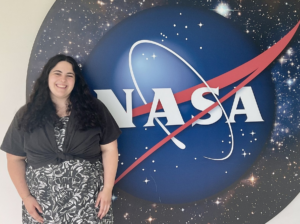
Kyla Mullaney at NASA Goddard Space Flight Center
Mullaney works in a branch of astronomy called extragalactic astronomy, which asks, “how do galaxies change over the very long scale of cosmic time?” Her research focuses on a specific facet of galaxy evolution: energetic processes driven by supermassive black holes and star formation. When active, supermassive black holes, often seated at the center of galaxies, consume matter through their unparalleled gravitational pull, while stellar feedback processes influence the energetic and chemical context for further star formation. Mullaney uses imaging data from a nearby Seyfert galaxy to understand how these energetic processes shape the galaxies they are in.
These data – incredibly dense high-resolution images covering a wide spectrum of wavelengths – require a powerful supercomputer to be processed into relevant metrics, such as markers of star formation or the movement of gas within a galaxy. Mullaney analyzes this information using high performance computing to disentangle energetic processes driving galaxy evolution, clarifying how different players contribute to making a galaxy.
“The really wide scales that we look at have always been interesting to me. The instruments that we use must have a margin of error much smaller than the width of a human hair. Yet, we’re also looking at targets that are hundreds of thousands of light-years wide and on completely opposite physical scales. I think that dichotomy — and the awe that comes with that – are really unique to astronomy.”
Tackling the Big Questions
Alongside her fascination with astronomy, Mullaney marvels at the collaboration required for this research. “What I really love about these huge science undertakings is that these problems are just too big for somebody to deal with on their own.”
While the stars in her backyard sparked her interest in space science, the collaborative temperament of science continues to fuel Mullaney’s zeal for astrophysics research. In her post-bac research, Mullaney has worked with scientists at every level and across different programs, and credits much of her positive experience to this teamwork.
“It wouldn’t be the vibrant and collaborative research group that it is without [these different people]. Everyone brings their own perspective and their own expertise that helps us solve these problems that I wouldn’t even know how to start on my own.”
For Mullaney, this collegiality illuminates a greater common purpose for her research. “I think it’s important to come together in order to see where we’re going as a galaxy and understand our shared space a little bit better.”
Growing as a Scientist
In addition to the team environment, Mullaney can list a multitude of resources that have benefitted her research journey, from YouTube videos that got her hooked on science early to the group of NASA post-docs who helped her with graduate school applications. In particular, she underscores the influence of outward-facing science initiatives on her love of space. In her own career, Mullaney hopes to “get people excited” about science by sharing her research beyond the lab with creative digital media and accessible data visualization.
As a SURA post-bac scientist, Mullaney has taken advantage of unique opportunities to strengthen her technical and professional skills. Through the program, she has presented her research at conferences, engaged in interdisciplinary colloquia at different universities, contributed to papers, including a first-authored paper under review, and learned from formal and informal mentors in the CRESST II ecosystem that spans NASA research scientists, university professors, and senior trainees.
CRESST II is a partnership between NASA Goddard Space Flight Center, SURA, and four universities that attracts scientific talent at every career stage to advance the space sciences mission at NASA, focusing on astrophysics and solar system exploration research. Through this program, SURA supports scientists like Mullaney, strengthening scientific talent to advance discovery and innovation at NASA.
What’s Next?
This fall, Mullaney will matriculate into a doctoral program at University of California, San Diego, where she will be funded by a Graduate Research Fellowship awarded by the National Science Foundation. Building on her post-bac research experience, she will continue to pursue extragalactic astronomy. As she steps into her next chapter, Mullaney will take with her a more comprehensive understanding of her research and a deeper sense of purpose derived from her time in the CRESST II program. “This program and the research that I’ve done here has been really transformative to the way I understand the larger field and the structure of galaxies as a whole.”
Although she is leaving NASA for her next degree, Mullaney hopes to stay connected to government research and programs like CRESST II. “Federal research and large-scale research institutes are something that I really enjoy because they have an extra sense of collaboration and so many people that work on vastly different things.”
As a SURA post-bac scientist in CRESST II, Mullaney has deepened her scientific expertise and professional capabilities while expanding our collective knowledge of galaxy evolution. Her contributions to NASA’s space science programs and the broader U.S. research enterprise lay the foundation for a promising research career as she pursues new discoveries yet to come.
“I’m excited to see how we’re going to untangle these mysteries in the future.”
Special thanks to Dr. Olivia Asher, 2026 AIBS & SURA Public Policy Fellow, for her contributions to this Scientist Spotlight.
About CRESST II
The Center for Research and Exploration in Space Science and Technology II (CRESST II) aims to support and enhance research and technology in the space sciences in support of NASA’s strategic science mission objectives while engaging a diverse population of students and PhD scientists in NASA’s space science programs.
About SURA
Southeastern Universities Research Association (SURA) advances the nation’s scientific enterprise through research operations and workforce solutions in partnership with government agencies, national laboratories, and its member universities.
Media Contact:
Anna Rader Groves
SURA Senior Advisor, Government Relations and Communications
Email: arader@sura.org
Artificial intelligence (AI) was used to edit for grammar, clarity, and coherence. All AI-generated suggestions were reviewed and approved by the author.