

SURA Honors Two Leading Researchers with 2025 Distinguished Scientist Awards
WASHINGTON D.C. ― The Southeastern Universities Research Association (SURA) proudly announces the recipients of its 2025 Distinguished Scientist Awards: Dr. Hans-Conrad zur Loye of the University of South Carolina and Dr. Anna-Lisa Paul of the University of Florida. The award, SURA’s highest honor, recognizes outstanding scientific leadership and transformative research in disciplines aligned with SURA’s mission and programs.
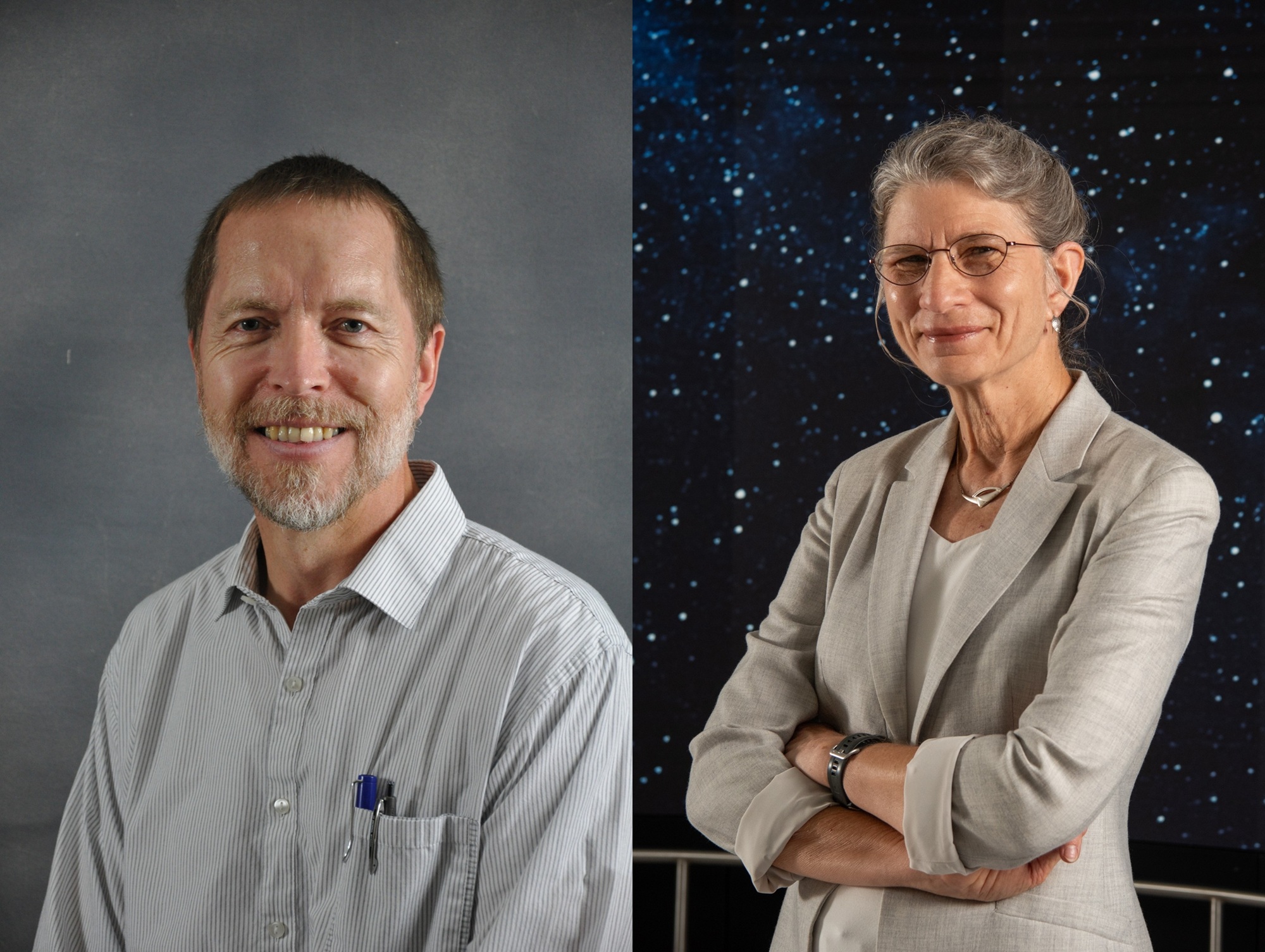
The 2025 honorees will be celebrated at the SURA Annual Meeting on October 8, 2025, in Washington, D.C., where they will be recognized for their far-reaching scientific contributions and exemplary leadership within their respective fields.
Dr. Hans-Conrad zur Loye serves as the David W. Robinson Palmetto & Carolina Distinguished Professor and Past Associate Dean for Research at the University of South Carolina’s Department of Chemistry & Biochemistry. A globally recognized leader in solid-state inorganic chemistry and crystal growth, Dr. zur Loye has spent nearly three decades developing novel complex oxides, fluorides, scintillators, and actinide-based materials—advancing their applications in areas such as electronics, magnetism, solid-state lighting, and nuclear waste immobilization.
He has pioneered high-temperature single-crystal growth techniques and introduced innovative hydroflux and reducing-flux methods to synthesize rare-earth phosphors. His work has enabled breakthroughs in advanced luminescent materials, including Eu²⁺-based compounds for next-generation lighting, and contributed critical insights to materials design for neutron diffraction applications at national user facilities. Notably, he leads the DOE-sponsored Center for Hierarchical Waste Form Materials, a major collaborative research center developing robust ceramic architectures to safely immobilize radioactive waste.
Dr. zur Loye’s impact is reflected in his h-index of 73, over 575 peer-reviewed publications, and more than 21,800 citations. His excellence in research and education has earned him many accolades, including the Carolina Distinguished Professorship (2018), South Carolina Governor’s Award for Excellence in Scientific Research (2016), Breakthrough Leadership in Research Award (2017), and the ACS Southern Chemist Award (2012). He is an elected Fellow of both the American Association for the Advancement of Science (AAAS) and the American Chemical Society (ACS). Early-career distinctions include the Exxon Award in Solid State Chemistry and the Camille & Henry Dreyfus New Faculty Award.
Beyond research, Dr. zur Loye is a committed mentor to students and early-career scientists. He has created a rich, hands-on training environment, providing access to advanced instrumentation and emphasizing critical skills in research leadership, time management, and professional development. Reflecting on his passion for discovery, he notes, “The goal is to have fun and make something that is new. It’s that thrill of discovery. In chemistry, you have to enjoy making things—and I do.”
“We are proud to see Dr. zur Loye honored with SURA’s highest award,” said Dr. Mary Anne Fitzpatrick, Executive Vice President for Academic Affairs and Provost, University of South Carolina. “His research has achieved international distinction, and this recognition affirms the University of South Carolina’s deep commitment to advancing scientific innovation through dedicated faculty leadership.”
Dr. Anna-Lisa Paul is a Research Professor in the Department of Horticultural Sciences and Director of the Interdisciplinary Center for Biotechnology Research (ICBR) at the University of Florida (UF). She co-leads the UF Space Plants Lab with colleague Rob Ferl, where their team investigates how plants respond to the unique stresses of orbital spaceflight and other novel exploration environments. Their research includes using the International Space Station (ISS) to study transcriptomic and epigenetic responses to living in space, using suborbital launch vehicles to study molecular processes during the transition to space, and growing plants in lunar regolith to explore the feasibility of sustained outposts on the Moon.
Dr. Paul served as the principal investigator on a NASA-funded experiment that provided the first evidence of epigenetic change in plants in response to growth in the spaceflight environment. These findings led to a second NASA grant to conduct a multigenerational plant experiment on the ISS to further study epigenetic inheritance.
She was also co-principal investigator on NASA’s first grant awarded for human-tended research in suborbital vehicles. That effort came to fruition in 2024 when her collaborator, Dr. Ferl, became the first university researcher to conduct their own experiment in space. Dr. Paul managed the ground-based control experiments from Blue Origin’s launch site in Texas.
In 2022, Drs. Paul and Ferl became the first scientists to successfully grow plants in lunar regolith collected during the Apollo missions. This groundbreaking research demonstrated that terrestrial plants could grow in soil created from materials readily available on the moon—an essential milestone in developing sustainable human outposts on the lunar surface and, eventually, Mars.
Dr. Paul’s research also reaches Earth’s most extreme environments. She has conducted experiments in Antarctica, using a containerized greenhouse to test space agriculture systems, and on Devon Island near the North Pole, simulating Martian farming techniques in an analog environment designed to withstand severe climates.
Reflecting on her work, Dr. Paul said, “My fundamental belief is that humans are explorers, and when we leave Earth’s orbit, plants will help us make the journey.”
She currently serves on the National Academies of Sciences, Engineering, and Medicine (NASEM) Committee on Biological and Physical Sciences in Space and co-chairs a NASEM panel developing a science strategy for the human exploration of Mars. Her many honors include the NASA Medal of Honor for Exceptional Scientific Achievement, and election as a Fellow of both the American Association for the Advancement of Science and the American Society for Gravitational and Space Research.
“Dr. Paul’s work exemplifies the spirit of exploration and scientific excellence,” said David Norton, UF’s vice president for research. “Her research is helping shape the future of human spaceflight and the role of plants in sustaining life beyond Earth.”
Established to recognize exceptional scientific contributions by researchers at SURA’s member institutions, the SURA Distinguished Scientist Award honors individuals whose innovative research has had a transformative impact in their disciplines and demonstrated outstanding leadership in science and engineering.
The Southeastern Universities Research Association (SURA) is a consortium of 57 leading research institutions across the southeastern United States. SURA fosters collaborations that amplify its members’ capacity to address bold, cross-disciplinary scientific challenges. It manages the Thomas Jefferson National Accelerator Facility (Jefferson Lab) in Newport News, Virginia, on behalf of the U.S. Department of Energy’s Office of Science.
Media Contact:
Marita Guliashvili
SURA Events and Office Coordinator
Email: mguliashvili@sura.org